CLAIM:
The process of receiving siddha-pranali is not mentioned anywhere in the granthas of the six Goswamis. It is therefore inauthentic and this cheating should be stopped.
ANSWER:
The process of the revealing of the siddha deha (the information thereof) is not mentioned in the writings of the Six Goswamis.
But most certainly the Goswamis of Vrindavana were well aware of this process.
A practical example of an introduction to a manjari-svarupa is found in the sixth chapter of Prema-vilasa, as Sri Gopala Bhatta Gosvami bestows the diksha-mantras to Srinivasa Acarya.
One thing we have to understand FIRMLY: the revealing of the siddha deha is a VERY CONFIDENTIAL thing. It is between Gurudeva and disciple. It is the most intimate and the most private exchange.
There are many reasons why the six Goswamis have not clearly mentioned the PROCESS of revealing the siddha deha, but they wrote about our eternal forms many times. Just check Srila Rupa Goswami´s Bhakti-Rasamrita Sindhu or the Caitanya Caritamrita.
And of course, in our main grantha, the Srimad Bhagavatam:
tvaṁ bhakti-yoga-paribhāvita-hṛt-saroja
āsse śrutekṣita-patho nanu nātha puṁsām
yad-yad-dhiyā ta urugāya vibhāvayanti
tat-tad-vapuḥ praṇayase sad-anugrahāya
(Srimad Bhagavatam 3.9.11)
“O Lord! You, who are approached by being heard about, seen and directly served, enter and remain in the lotus of your devotee’s hearts infused with bhakti-yoga.
Much praised Lord! By your mercy, you bestow to them spiritual bodies appropriate to the mood they cultivate during sādhana.”
Srila Viśvanātha Cakravartī Ṭhākura explains – te sādhaka-bhaktāḥ sva sva bhāvānurūpaṁ yad yad dhiyā bhāvayanti tat tad eva vapus teṣāṁ siddha dehaṁ praṇayase prakarṣeṇa tān prāpayasi aho te sva bhakta pāravaśyam iti bhāvaḥ –
“Or your devotees doing sādhana concentrate on their spiritual form according to their mood of love using their minds, and you have them attain (praṇayase) their spiritual bodies. You become dependent on your devotee.”
This verse allows a second translation:
“O my Lord, Your devotees can see You through the ears by the process of hearing, and thus their hearts become cleansed, and You take Your seat there. You are so merciful to Your devotees that You manifest Yourself in the particular eternal form of transcendence in which they always think of You.”
Srila Vishvanatha Cakravartipad in his tika mentions both translations because both are fully valid.
We can only SEE or RECOGNIZE Sri Krishna with a spiritual body, which is bestowed to us by Him (or which we will ATTAIN/REALIZE).
The concept of an eternal spiritual body, a siddha-rupa, in the realm of Gaudiya-theology makes its famous appearance in Sri Rupa Gosvami’s Bhakti-rasamrita-sindhu, in a section, where the practice of raganuga-bhakti-sadhana is explained.
sevā sādhaka-rūpeṇa siddha-rūpeṇa cātra hi |
tad-bhāva-lipsunā kāryā vraja-lokānusārataḥ ||1.2.295||
“Following after the inhabitants of Vraja, one should perform service in one’s physical body and in one’s siddha body, with a desire for a particular bhāva.”
In the famous Caitanya Caritamnrita, we can read about this siddha deha too:
Sriman Mahaprabhu taught Sanatana Goswami:
mane nija siddha‑deha kariyā bhāvana –
“Use the mind for contemplating your siddha deha.”
(CC 2.22.157)
The Lord similarly instructed Ramananda Raya:
siddha dehe cinti kore tāhāi sevana –
“Visualize your siddha deha and mentally serve in that form.”
(CC 2.8.228)
One reason is because the six Goswamis are eternal associates of Mahaprabhu.
Who would volunteer to give Srila Rupa Goswami “siddha pranali”?
Do we REALLY know that Srila Rupa Goswami NEVER gave siddha pranali to anyone? Or ANY Goswami, for that matter?
It was and is still the most private thing.
Some tasks in spreading the glories of Gaudiya Vaishnava siddhanta were given to certain individuals (as we can see even until today!).
Sriman Mahaprabhu entrusted the responsibility for promoting the details of these instructions (about the siddha deha and the process of its “revelation”) to Sri Gopal Guru Goswami who, as the foremost disciple of Vakreshwar Pandit, became intimately connected with the Lord during his last eighteen years at Puri.
Due to his close relationship with Svarupa Damodar also, Gopal Guru Goswami gained an exceptional insight into Sriman Mahaprabhu’s internal movements.
This pleased the Lord so much that he selected him to be the first acharya of the Gambhira after his departure. The Lord also instructed him to write a paddhati on siddha pranali and lila smaran, and awarded him the title of guru.
Among the five chief disciples of Śrī Vakreśvara Paṇḍita, Gopālaguru was the special object of Mahāprabhu’s mercy. He was the son of Murāri Paṇḍita, and his name was Makaradhvaja Paṇḍita, although Mahāprabhu called him Gopāla. When Śrī Gaura lived in Nīlācala, Gopāla engaged in His service. Even though he was still a child, he was very skillful in his sevā. The Lord showed very strong vātsalya affection for him, and personally gave him the title “Gopālaguru.”
One day, Caitanya Mahāprabhu went outside the village to tend to his bodily needs. Gopāla was standing some distance away with a waterpot in his hand ready to serve the Lord. He noticed that the Holy Name, which always blissfully danced on Mahāprabhu’s tongue, was not to be heard. Wondering how this could be, he then saw that the Lord was holding his tongue with his hand. After a short while, Gopāla, being full of curiosity, inquired from the Lord, “Prabhu! Why are you holding your tongue like that?” Mahāprabhu answered, “The words kṛṣṇa kṛṣṇa always dance on my tongue, and even when I’m unclean they don’t stop. One is forbidden to chant the kṛṣṇa-nāma mahā-mantra when he is unclean. Transgressing that injunction is an offense. For this reason, I hold my tongue to keep it still.”
Gopāla replied, “Prabhu! Elegant words don’t adorn my little mouth, but still, in order to understand, I am asking. Your beautiful body doesn’t have a trace of uncleanliness. It is sac-cid-ānanda-maya and always pure. Your ‘going to the bathroom’ is an illusion. That’s just your pretending to be human. You are independent, but if an ordinary jīva should die while evacuating, without chanting the Holy Name, how will he attain the transcendental state?”
Hearing these profound words from the boy, the Lord replied, “Gopāla, you have spoken correctly. In chanting the śrī-kṛṣṇa-nāma there is no consideration of cleanliness or uncleanliness. Chanting is always auspicious for the jīva. You have caused me to remember the highest injunction. From today, you shall bear the title guru.” Mahāprabhu told the devotees this story, and the news quickly spread everywhere. Soon all the Vaiṣṇavas began to call Gopāla “Śrī Gopālaguru.”
Gopālaguru Gosvāmī became the ācārya of the Gambhīrā Maṭha, and when he became old, he wanted to arrange for someone to continue the worship of Śrī Śrī Rādhā-Kānta. To obtain a suitable sevaka, he offered a mental prayer to the lotus feet of Śrīman Mahāprabhu. One night, the Lord appeared to Gopālaguru and said, “Gopāla! The sevaka you seek will be the first person you see tomorrow morning. Accept him without hesitation. Like you, he will be learned in all the transcendental śāstras. He will preserve well the worship of Śrī Śrī Rādhā-Kānta and reveal my glories to the whole world.”
Hearing this order from Mahāprabhu in his dream, Gopālaguru became ecstatic. The next morning, after his morning duties, he went to his doorway. The first person he saw was a very peaceful young brāhmaṇa who had been standing there waiting to see him. When the youth approached, he offered daṇḍavats to Gopālaguru’s lotus feet. The Gosvāmī remembered his dream and blissfully offered the young man his blessings. Seeing his peaceful nature and absorption in kṛṣṇa-bhakti, Gopālaguru gave him mantra-dīkṣā, etc., and named him Śrī Dhyānacandra.
After receiving initiation, Śrīpāda Dhyānacandra served his guru with great devotion. Gopālaguru Prabhu engaged him in caring for Śrī Śrī Rādhā-Kānta.
After a short while in govinda-sevā, he received the dress of a Vaiṣṇava ascetic from his guru, and was then ordered to visit Śrī Vṛndāvanadhāma.
Later, Sri Dhyanachandra Goswami was also ordered to compile a second paddhati which has received equal acclaim.
Still later, following these two arcana-paddhatis, Sri Siddha Krishna Das compiled his Sādhanāmṛta-candrikā, which combines upāsaka-pariṣkṛti, lila smaran, archan, dhyana and the duties of a sadhaka all in one book.
These three paddhatis have been recognized as the foundation of archanam and smaranam in the Gaudiya Sampradaya, and are commonly referred to as Paddhati-traya.
It is to draw attention to the authority of Sri Gopal Guru and Dhyanachandra Goswami that Srila Bhaktivinoda Thakur includes them in his book called Jaiva-dharma.
In its narrative story, Gopal Guru is given the important role of Sri Guru Goswami who awards siddha pranali to his qualified disciple Vijaya Kumar.
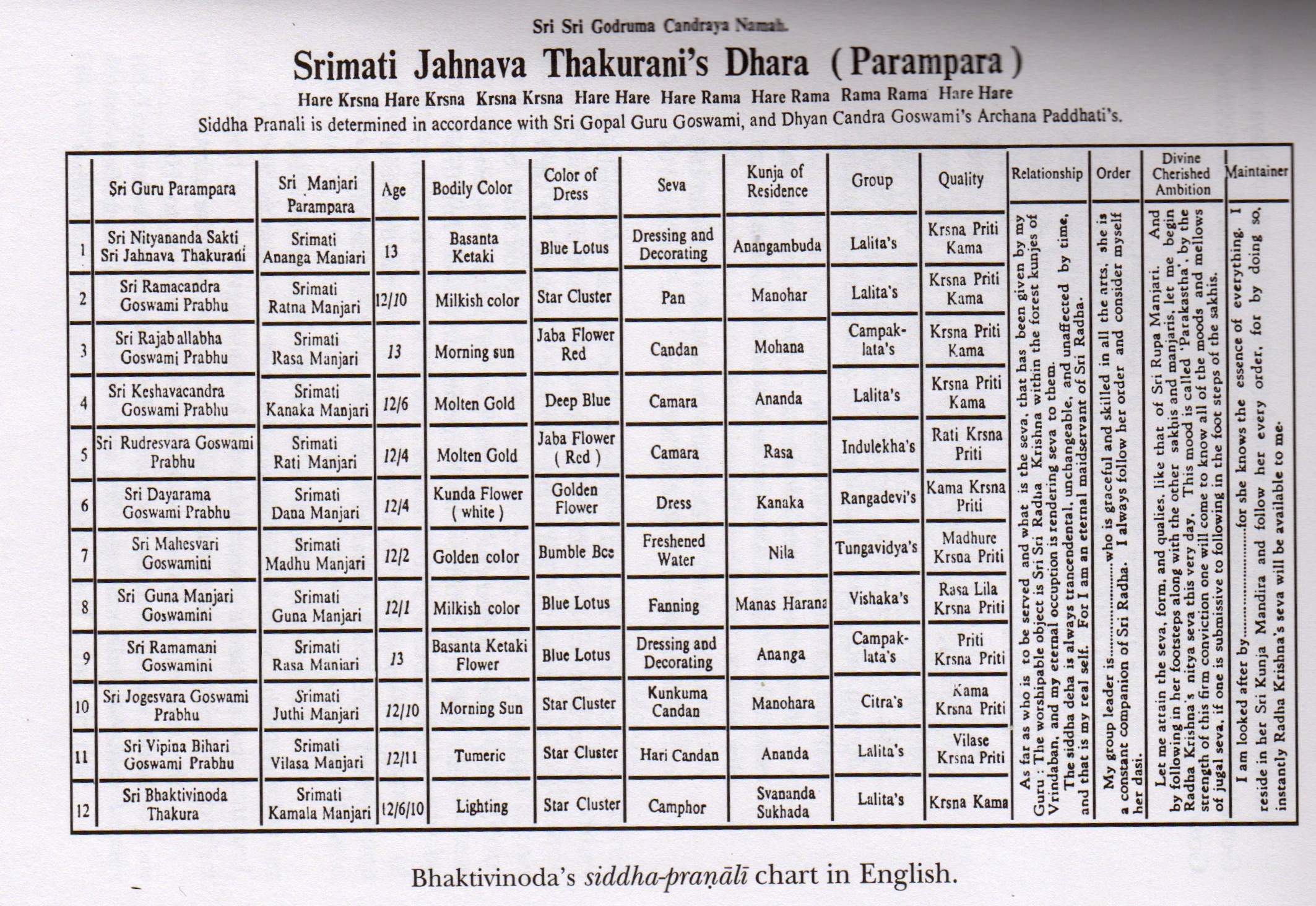
Thakur Bhaktivinoda thus supports Gopal Guru Goswami, the authenticity of siddha pranali, and its important function as well. In fact, nowadays we can find his personal siddha-pranali chart and read it in amazement
So, the first time the process of siddha pranali is mentioned anywhere in the canon of Gaudiya Vaishnava literature is in the famous paddhati of Srila Dhyanachandra Goswami, called Śrī Gaura-Govindārcana-Smaraṇa-Paddhatiḥ.
It is also mentioned by Vṛndāvana Cakravartī, a disciple of Viśvanātha Cakravartī, in his commentary on Govinda Līlāmṛta (23.94 – manobhāvena yogya vapuṣā śrī gurvājñā tat sevā-yogya siddha vapuṣā), but, though it is not called siddha praṇālī literally by name, the principle of the Guru’s involvement with the disciple’s development of the spiritual body is also clearly mentioned in the Gosvāmīs’ books. For instance, in Śrī Jīva Goswāmī’s Bhakti Sandarbha (283):
divyaṁ jñānaṁ hy atra śrīmati mantre bhagavat-svarūpa-jñānaṁ tena bhagavata sambandha-viśeṣa-jñānaṁ ca
“This divine knowledge is in the beautiful mantra and is knowledge of the Lord’s real form. Through it one receives knowledge about one’s specific relationship with the Lord.”
And in paragraph 312 of Bhakti Sandarbha:
yathā caike tādṛśam upāsanaṁ sākṣād vraja-jana-viśeṣāyaiva mahyaṁ śrī-guru-caraṇair mad-abhīṣṭa-viśeṣa-siddhy-artham upadiṣṭaṁ bhāvayāmi
Some of them, while performing such worship through the mantra, contemplate in this way: “I am directly a specific resident of Vraja, and although I am meditating on this mantra, taught by my guru, so that I may attain the specific service of Kṛṣṇa for which I aspire, Vrajendra-nandana, Śrī Kṛṣṇa, is directly being served by me.”
I also found another translation of this deep and meaningful verse:
“In such a worship (with the 18-syllable Gopāl-mantra) I meditate to develop myself as a direct, specific person in Vraja as my Śrī Guru’s lotus-feet have instructed me in to attain the specific siddhi I covet.”
Difference:
Some say the instruction is in the upasana (worship), not in the form.
Some say the instruction is in the upasana AND in the form.
The identity and the mantra have been tied together in the earlier mentioned passage on diksha (283) and so on (divyam jnanam) in the same book.
Śrīla Narottama Dās Ṭhākur sings in Prārthanā (30):
kanaka kaṭorā pūri, sugandhi candana būri,
doṅhākāra śrī-aṅge ḍhālibo
guru-rūpā-sakhī vāme, tribhaṅga bhaṅgima ṭhāme,
cāmarera bātāsa koribo
“With fragrant sandal paste filling a golden jug, I anoint their beautiful limbs. Standing on the left side of my guru-rūpā-sakhī (my Guru in his sakhī-form) before Kṛṣṇa with His three-fold bending form, I fan with a cāmara-whisk.”
One may argue here that this is written in a siddha-state, but the song in which this couplet appears is named svābhiṣṭa lālasā, ‘yearning for a desired condition’ – clearly it speaks about a sādhaka-condition.
CLAIM:
You always argue that Srila Bhaktivinod Thakur received siddha-pranali. As for the siddha-pranali chart of Srila Bhaktivinoda Thakura, we can say that he infiltrated the caste Gosvami community in Bengal in order to reform them, so it was necessary to compromise at first.
(THESE ARE THE EXACT WORDS OF A FAMOUS LIVING GURU OF THE GAUDIYA MATH, NOT MADE UP BY THE AUTHOR OF THIS BLOG!)
ANSWER:
Where is evidence for this statement in ANY of the books, letters, songs. lectures of Srila Bhaktivinod Thakur? We never heard any acarya of the Gaudiya Math claim such a statement.
In fact, we can find this nectar:
In the last chapter of Śrī Harināma-cintāmaṇi, Thakur Bhaktivinoda writes:
sādhite ujjvala-rasa āche bhāva ekadasa
sambandha vayasa nāma rupa
yūtha veśa ājñā vāsa sevā parākāṣṭhāśvāsa
pālya-dāsī ei aparūpa
“In order to fulfill one’s ambitions for attaining madhura rasa there are eleven items: relationship, age, name, form, group, dress, order, residence, seva, highest ambition, and the sakhi one serves under.”
(Hnc 15.58)
And it is Srila Thakur Bhaktivinoda who most wonderfully summarizes the process of receiving siddha pranali from the guru as follows:
sādhaker jokhon rāganugā mārga lobha hoy, tokhon
sad-gurur nikaṭa prārthanā korile tini sādhaker
ruci parīkṣā koriyā tāhār bhajan nirṇoyer
saṅge saṅge siddha-deher paricaya koriyā diben.
“When the sadhaka’s lobha for raganuga bhakti is awakened, he approaches his gurudeva with great humility and ask for instruction. If he does so, the bonafide guru first examines the disciple’s taste and then, along with devising the appropriate bhajan introduces him to his own siddha identity.”
(Śrī Caitanya-śikṣāmṛta, Part 6, chapter 5)
In Śrī Harināma-cintāmaṇi (15.59-60), Srila Bhaktivinoda gives a more detailed description of how this process is to take place:
ei ekādaśa bhāva sampūrṇa sādhane
pāñca daśā lakṣya hoy sādhaka jīvane
śravaṇa, varaṇa āra smaraṇa, āpana
sampatti ei pañca vidha daśāy gaṇana
The sadhana relating to the eleven items of siddha pranali or ekadasa bhava is executed in five progressive stages:
1) śravaṇa-daśa, the stage of hearing;
2) varaṇa-daśa, the stage of accepting;
3) smaraṇa-daśa, the stage of remembering;
4) āpana-daśa, the mature stage;
5) sampatti-daśa, the full attainment of the goal.