(This is a fictive dialogue, based on real events)
Sadhaka:
Dearest Gurudeva, you very nicely instructed me in the matter of raganuga-bhakti.
Recently some Vaishnavas were of the opinion that actually we have to practice vaidhi-bhakti until we reach the stage which Srila Rupa Goswami named “RUCI” in his Bhakti-Rasamrita-Sindhu.
They claimed that Srila Jiva Goswami wrote in the Bhakti Sandarbha that we can only start with raganuga-bhakti at the stage of ruci.
What can you say about this?
Gurudeva:
My dear child. First of all, like I instructed you before, we have to know about raganuga-bhakti and vaidhi-bhakti.
They are two different paths of bhakti. Also, their causes and their destinations are completely different.
Here are again the main shastric references to these two eternally distinct paths:
vaidhi raganuga ceti sa dvidha sadhanabhidha || (bhakti rasamrita sindhu 1.2.5)
“Practice is of two kinds, namely vaidhi and raganuga.” The word “vaidhi” is derived from the Sanskrit word “vidhi”, referring to the commandments of the scriptures. The word “raganuga” is a compound of two words, namely raga, “loving attachment”, and anuga, “following in the wake of”. The general characteristics of these two paths are explained as follows:
vaidhi-bhaktir bhavet sastram bhaktau cet syat pravartakam |
raganuga syac ced bhaktau lobha eva pravartakah || (raga vartma chandrika 1.3)
“When devotion is caused by scriptural injunctions, it is called vaidhi-bhakti, but when its cause is spiritual greed alone, it is called raganuga-bhakti.”
yatra raganavaptatvat pravrittir upajayate |
sasanenaiva sastrasya sa vaidhi-bhaktir ucyate || (brs 1.2.6)
“That devotion which knows no attachment or greed, but which is prompted by the commandments of the scriptures, is called vaidhi-bhakti.”
virajantim abhivyaktam vrajavasi-janadishu |
ragatmikam anusrita ya sa raganugocyate || (brs 1.2.270)
“The devotion which is clearly present in the associates of the Lord in Vraja is called devotion filled with loving attachment (ragatmika-bhakti), and devotion following in the wake of this ragatmika-bhakti is called raganuga-bhakti.”
vaidhi-raganuga-marga-bhedena parikirtitah |
dvividhah khalu bhavo’tra sadhanabhinivesajah || (brs 1.3.7)
“The paths of vaidhi and raganuga are known to be separate from each other.
Engagement in these two forms of practice certainly awakens two distinct varieties of bhava.”
The goals of these two paths of devotion in practice are understood as follows:
vidhi-bhaktye parshada-dehe vaikunthete yaya || (caitanya caritamrita 2.24.87)
“Through vidhi-bhakti, one will attain the form of an associate in
Vaikuntha.”
aisvarya-jnane vidhi-bhajana kariya |
vaikunthake yaya catur-vidha mukti pana ||
(cc 1.3.17)
“Those who worship according to scriptural commandments, being aware of the Lord’s superhuman prowess, attain the four kinds of liberation in Vaikuntha.”
raga-bhaktye vraje svayam-bhagavane paya || (cc 2.24.85)
“Through raga-bhakti, one will attain the Lord Himself in Vraja.”
raganuga-marge tanre bhaje yei jana |
sei-jana paya vraje vrajendra-nandana ||
(cc 2.8.221)
“He who worships on the path of raganuga will attain Vrajendranandana (Sri Krishna) in Vraja.”
In the realm of Vraja, the sweet and intimate human-like pastimes of God prevail. Only in such an atmosphere love can attain its pinnacle. Love which is filled with awareness of the Lord’s almight is of an inferior quality. As stated by the Lord Himself:
sakala jagate more kare vidhi-bhakti |
vidhi-bhaktye vraja-bhava paite nahi sakti ||
aisvarya-jnanete saba jagat misrita |
aisvarya-sithila-preme nahi mora prita ||
(cc 1.3.15-16)
“Everyone in this world worships Me through vidhi-bhakti. Vidhi-bhakti has no power for attaining the feelings of Vraja. The devotion of the world is mixed with knowledge of My divine prowess. I do not delight in love diluted with prowess.”
It is thus evident that there is a need to deeply reflect on the nature and practice of raganuga-bhakti for anyone who desires to perfect his loving faculty in relationship with God. There is no other means for tasting the ambrosial sweetness of the Vraja-pastimes of the Lord!
karma, tapa, yoga, jnana, vidhi-bhakti, japa, dhyana |
iha haite madhurya durlabha ||
kevala ye raga-marge, bhaje krishne anurage |
tare krishna-madhurya sulabha ||
(cc 2.21.119)
“Sweetness is very difficult to attain through fruitive activities, austerity, yoga, intellectual speculation, vidhi-bhakti, recitation of mantras or meditation. The sweetness of Sri Krishna is easily attainable only for the one who affectionately worships Him on the path of raga.”
So you can see, it is very very clear.
Of course the items or “angas” of bhakti which will be performed may be “the same”, like chanting, hearing, worshiping, etc…but the difference is the inner consciousness.
A raganuga-sadhaka only practices the items of bhakti which are condusive to his inner mood, which support the sadhaka in following the people of Vraja.
Srila Vishvanath Cakravartipada write in his Raga-Vartma-Chandrika:
How to follow in the footsteps of the people of Vraja? In one’s physical body one follows in the footsteps of Srila Rupa Gosvami and other saints that lived in Vraja and in the mentally conceived spiritual body one follows in the footsteps of Srimati Rupa Manjari and other eternal associa¬tes of Krishna.
The people of Vraja that should be followed in the sadhaka rupa, such as Candrakanti, the sages of the Dandaka-forest, whose story is related in the Brihad Vamana Purana, as well as the srutis (Upanishads), have attained their spiritual relati¬onship with Krishna. One should act like these Vrajavasis. In this way the first two verses described smarana and living in Vraja and the third verse (1.2.296) describes practices such as hearing about Krishna’s pastimes. All other limbs of devotional practice, such as taking shelter of the feet of the guru, are attained through the practice of hearing and chanting. Without hearing and chanting one’s allegiance to the people of Vraja will be unsuccessful, hence the word manishibhih was used. This means that intelligent persons will, with the help of their sense of discrimination, practise those limbs that are favorable to one’s own devotional feelings and not those that are opposed to that.
And:
The scriptures show five kinds of devotional practices to make clear which other limbs of devotion are to be practised in raganuga bhakti, what they are like, what are their characteristics, what is to be done and what is not to be done. They are: those filled with the desired feeling, those related to the desired feeling, those favo¬rable to the desired feeling, those not opposed to the desired feeling and those opposed to the desired feeling. Of them some are both the practice and the goal (the only difference between them being that the former is an ‘unripe’ stage and the latter is the ‘ripe stage’), some are the direct cause of attaining the goal (prema), some the indirect cause, some are helpful, some are harmful and some are neutral. All these divisions have been shown.
So, quite honestly, if a sadhaka takes shelter of a raganuga Gurudeva, this Gurudeva will surely know how to instruct the disciple on what to practice and what not.
Sripad Satyanarayana das Babaji writes on this subject:
Śrī Kapila defines bhakti as activities of the senses in relationship to Bhagavān, with no motive other than pleasing Him, and without being obscured by non-essential activities suited to the pursuit of jñāna or karma, executed according to the injunctions stated in the bhakti literature by a person who has accepted a mantra from a spiritual teacher.
This bhakti has two divisions, vaidhī and rāgānuga bhakti. In the beginning, as sādhana, vaidhī bhakti lacks in intensity and is asvābhāvikī — practiced externally, without natural inclination to it. When this practice attains successful maturity, however, it becomes natural ( svābhāvikī) at the perfect stage (sadhya) as vaidhī-bhāva-bhakti.
If from the beginning, this bhakti is practiced with a natural inclination and a sense of relationship to Kṛṣṇa, even if only imperfectly or not very intensely, it is called rāgānuga sādhana bhakti. When it attains successful maturity, it becomes rāgānuga bhāva bhakti. This distinction between vaidhī bhāva bhakti and rāgānuga bhāva bhakti is also described in Bhakti-rasāmṛta-sindhu.
From this explanation of Viśvanātha Cakravartī Ṭhākura, it is very clear that vaidhī bhakti and rāgānuga bhakti are two separate classes of bhakti from their very inception, and they continue to remain separate even in their mature state. Confusion arises because vaidhī bhakti does lead to a svābhāvikī bhakti which has something in common with rāgānuga bhakti — natural inclination. However, practice of vaidhī bhakti does not automatically lead to rāgānuga bhakti. The seeds of vaidhī and rāgānuga are separate and yield separate results. Although the same terminology is used for both of them, namely sādhana bhakti, bhāva bhakti and prema bhakti, one must know that these three divisions of bhakti relating to vaidhī and rāgānuga are completely distinct. This is very clearly stated in Bhakti-rasāmṛta-sindhu 1.2.1 and 1.2.5-6.
Sadhaka:
Thank you. So it may look from the outside as if a vaidhi- and a raganuga-bhakta are “doing” the same, but with a different inner mood or feeling?
Gurudeva:
Yes.
Now let us go on. You said that some Vaishnavas claim that the sadhaka has to be on Srila Rupa Goswami´s mentioned stage “RUCI” in order to practice raganuga-bhakti.
Let us just see what Srila Vishvanatha Cakravartipad has to say about this:
atha raganuga bhakti majjanasyanartha nivritti nishtha-rucyasaktyantaram prema-bhumikarudhasya sakshat svabhishta-prapti-prakarah pradarsyate. yathojjvala nilamanau “tad bhava baddha raga ye janas te sadhane ratah. tad yogyam anuragaugham prapyotkanthanusaratah. ta ekaso’thava dvi-trah kale kale vraje’bhavan” iti. anuragaugham raganuga bhajanautkanthyam natvanuraga sthayinam sadhaka-dehe’nuragotpattyasambhavat. vraje’bhavann iti avatara samaye nitya priyadya yatha avirbhavanti tathaiva gopika-garbhe sadhana-siddha api avirbhavanti. tatas ca nitya-siddhadi gopinam maha-bhava-vatinam sanga mahimna darsana sravana kirtanadibhih sneha mana pranaya raganuraga maha-bhava api tatra gopika-dehe utpadyante. purva janmani sadhaka-dehe tesham utpattyasambhavat. ataeva vraje krishna preyasinam asadharanani lakshanani. yad uktam – “gopinam paramananda asid govinda darsane. kshanam yuga-satam iva yasam yena vina bhaved” iti. “trutir yugayate tvam apasyatam” ityadi ca. kshanasya yuga satayamanatvam maha-bhava lakshanam.
Now it will be described how the raganugiya bhakta gradually advances through the stages of anartha nivritti (cessation of bad habits), nishtha (fixation), ruci (taste), and asakti (attachment to the beloved deity) upto the stage of prema (love of God) and the direct attainment of his beloved deity. In the Ujjvala Nilamani it is said that ‘those who are specially attracted to the ecstasy of the Vrajavasis and thus perform raganuga bhajana will attain that abundance of eagerness that is fit for performing raganuga bhajana and will take birth in Vraja in groups of one, two or three in their own time, according to their eagerness.’ Here the word anuragaugha means ‘that eagerness that makes one qualified for doing raganuga bhajana’. The anuraga mentioned here does not refer to the sthayi bhava (permanent mood) of that name, because the sthayi bhava named anuraga cannot be attained within a material body. The words ‘having taken birth in Vraja’ means the sadhana siddhas take birth from the womb of a gopika, just as Krishna’s eternally beloved gopis appear with Him when He descends to earth (prakata lila). After that, gradually sneha, mana, pranaya, raga, anuraga and mahabhava will become manifest in the gopika-body of that sadhaka on the strength of associating with the gopis that are endowed with maha-bhava and by hearing and chanting and seeing the greatness of Krishna’s eternally liberated gopis. These feelings could not possibly have arisen in the material body of the sadhaka, in his previous birth. In this way the extraordinary characteristics of Sri Krishna’s beloveds in Vraja has been shown. In Srimad Bhagavata it is said that the gopis attained the pinnacle of transcendental bliss by seeing Govinda. Without Him, they experienced a moment to last like a hundred ages. Their statement (in Srimad Bhagavata 10.31.15) ‘Without seeing You, we consider a second to last like an age’, is a symptom of mahabhava.
Clearly he mentions the progression of the raganuga sadhaka through Srila Rupa Goswami´s stages of bhakti.
Now, I also know exactly which verses Srila Jiva Goswami is writing:
yasya purvoktam raga-viseshe rucir eva jatasti na tu raga-visesha eva svayam, tasya tadrisa-raga-sudhakara-karabhasa-samullasita-hridaya-sphatika-maneh sastradi-srutasu tadrisya ragatmikaya bhakteh paripatishv api rucir jayate | tatas tadiyam ragam rucy-anugacchanti sa raganuga tasyaiva pravartate ||
(Bhakti-sandarbha 310)
“When even a semblance of the moonrays of raga shines upon the crystal-like heart of a person in whom a taste for the aforementioned specific raga has awakened, but who himself does not possess distinct raga, his heart rejoices. He then hears from the scriptures about such ragatmika-bhakti and consequently develops a taste for the same. Following his taste for such raga, he engages in raganuga-bhakti.”
Srila Ananta das Babaji Maharaja writes about this:
…tatparya ei ye, ye bhakter hrdoy svaccha arthat kama krodha matsaryadi bhave dusit nohe, sei bhakta sastra o sadhu mukhe ragatmika bhakter premamayi seva paripatir visay sravana korile tahate tahar rucir udoy hoya thake…
…that bhakta whose heart is transparent, which means, not polluted by lust, anger, envy and other feelings,
if such a bhakta hears from shastra and sadhus about the loving expertise of the ragatmika bhaktas he gets ruci for that…
This is not about raganuga-sadhana-bhakti beginning from letter “A”, but about raganuga-bhakti with deep taste, leading to raganuga-bhava-bhakti and then to raganuga-prema-bhakti.
Nowhere here can we read:
“YOU CAN`T PRACTICE RAGANUGA-BHAKTI WITH A DIRTY HEART”. The opposit is true: raganuga-sadhana-bhakti has much more power to clean the heart than vaidhi-sadhana-bhakti.
For the full manifestation of the RAGA of the RAGATMIKA devotees in our hearts, yes, our hearts must be pure.
Until that point, we eagerly practice raganuga-bhakti-sadhana in the anugatya of Sri Gurudeva.
Here, “not polluted by lust, anger or greed” is not referring to the stage of being FULLY LIBERATED from all unwanted desires. It means that the rays of raga will make a pure heart rejoice quite a lot.
When the rays of raga fall on an impure heart, it will have not the same effect or impact. But it will purify our hearts more and more by the mercy of Gurudeva, the sa<dhus and Krishna.
But what if our hearts are not yet like crystals? But we still feel greedy for practicing raganuga-bhakti?
Srila Jiva Goswami gives us hope:
ajata-tadrisa-rucina tu sad-viseshadara-matradrita raganugapi vaidhi-samvalitaivanushtheya |
tatha loka-samgrahartham pratishthitena jata-tadrisa-rucina ca |
atra misratve ca yatha-yogyam raganugayaiki krityaiva vaidhi kartavya ||
(Bhakti-sandarbha 312)
“Those in whom such taste (ruci) has not awakened, but who have a special interest for it, should engage in a mixture of raganuga and vaidhi.
For the sake of establishing an example for the people of the world, the one in whom such ruci has awakened will do the same. Therefore, as appropriate, raganuga should be performed together with vaidhi.”
Exclusive and pure raganuga-bhakti really commences when the heart is pure.
But that doesn´t mean that raganuga-bhakti-sadhana starts at the stage of RUCI.
Like Sripad Satyanarayana das Babaji wrote:
If from the beginning, this bhakti is practiced with a natural inclination and a sense of relationship to Kṛṣṇa, even if only imperfectly or not very intensely, it is called rāgānuga sādhana bhakti. When it attains successful maturity, it becomes rāgānuga bhāva bhakti. This distinction between vaidhī bhāva bhakti and rāgānuga bhāva bhakti is also described in Bhakti-rasāmṛta-sindhu.
We follow a mixture of vaidhi and raganuga-bhakti until our hearts are like crystals and then we are solely on the path of raganuga-bhakti.
Now, here we have to consider the use of the word “RUCI” here. “RUCI” simply means taste. Now, Srila Rupa Goswami categorized the stages within bhakti from sraddha (faith) to prema (pure love) and he gave each consequent stage a meaningful word.
In Srila Rupa Goswami´s ascending stages within bhakti, “RUCI” is the stage after “NISTHA” (firm faith), when nearly all unwanted desires are gone (anarthas). So Srila Rupa Goswami´s used the word “RUCI” (taste) to explain a VERY HIGH stage within bhakti. But this is not what Srila Jiva Goswami writes about here. “RUCI” means “TASTE” here in these verses and Srila Vishvanatha Chakravartipada confirms too that a slight taste (ruci) is sufficient to start practicing raganuga-bhakti.
We don´t practice ONLY vaidhi-bhakti until we qualify for raganuga-bhakti. Like said above, it may be like a mixture, but when taste (ruci) awakens in our heart to follow the Vrajavasis, we start with raganuga-bhakti.
Like the word “BHAVA”. Srila Rupa Goswami uses this word, bhava, in describing the very stage before PREMA, purest love of God. But actually BHAVA means literally “MOOD, EMOTION, FEELING”.
There are material bhavas and spiritual bhavas. Same with the word “RATI”. It means “DEEP AFFECTION”. I can have RATI for my children, but this has nothing to do with the stage Srila Rupa Goswami is describing as “RATI”.
The symptoms of the awakening of greed for attaining feelings akin to the Lord’s eternal associates is described as follows:
tat tad bhavadi madhurye srute dhir yad apekshate |
natra sastram na yuktim ca tal lobhotpatti lakshanam ||
(brs. 1.2.292)
“When one hears about the sweetness of their feelings and so forth, and a desire for attaining the same awakens in the consciousness without dependence on scripture and logic, this is a symptom of the awakening of greed (lobha).”
vrajalila parikarastha sringaradi bhava madhurye srute dhir idam mama bhuyat iti lobhotpattikale sastra yukty apeksha na syat satyam ca tasyam lobhatvasyaivasiddheh | nahi kenacit sastra drishtya lobhah kriyate napi lobhaniya vastu praptau svasya yogyayogyatva vicarah ko’py udbhavati. kintu lobhaniya vastuni srute drishte va svata eva lobha utpadyate ||
(rvc 1.5)
“If, upon hearing of the sweetness of the feelings, headed by passion, of Sri Krsna’s associates in the Vraja-lila, one thinks, ‘Let me also attain such feelings,’ then at this time one need not depend either on the revealed scriptures or on favorable logical considerations. If such dependence remains, it cannot be said that greed has appeared. Greed never arises in anyone because of scriptural considerations, and in anyone who is desirous to attain the object of the greed, no considerations of qualification or lack of qualification arise. Rather, greed arises only by hearing about the object of greed or by seeing it.”
Srimat Rupa Gosvami has given definitions of both these kinds of candidates, for vaidhi and raganuga bhakti. The definition of the vaidhi-marga’s candidate is as follows:
yah kenapyati bhagyena jata sraddho’sya sevane
natisakto na vairagya bhagasyam adhikaryasau
(Bhakti Rasamrita Sindhu 1.2.14)
“When, by a stroke of inconceivable luck, a person develops faith and liking for serving Krishna (bhakti marga) due to having associated with great saints, but has not yet attained firm attachment to the Lord and is only slightly averse to bodily attachments – such a person is eligible for sadhana bhakti.”
The candidate for raganuga is described as follows:
ragatmikaika nishtha ye vrajavasi janadayah
tesham bhavaptaye lubdho bhaved atradhikaravan
(Bhakti Rasamrita Sindhu 1.2.291)
“A person who is simply greedy after the unalloyed, ecstatic ragatmika bhakti-love for Krishna of the Vrajavasis, is a candidate for raganuga bhakti.”
The difference between the candidates for vaidhi and raganuga bhakti is that eligibility for vaidhi bhakti is caused by ‘sraddha’ (faith) and eligibility for raganuga bhakti is caused by ‘lobha’ (sacred greed). The candidate for vaidhi bhakti gradually advances in his sadhana by keeping his faith in the purports of the scriptures and some ruci gradually awakens as a result of his reverential attitude towards the Lord, and meets with his sraddha. But this ruci remains a secondary factor, and his bhajana continues mainly on the basis of his sraddha. And the candidates for raganuga bhakti are prompted by greed after the sweet feelings of the nitya siddha Vrajavasis. Their practice of ruci-sadhana gradually develops and meets with deep sraddha; but here sraddha remains the secondary factor and ruci the primary. He remains engaged in bhajana that bears the shape of sraddha, but in which ruci is primary. This is definitely different in kind from the sraddha that prompts vaidhi bhakti and much more powerful also, because the absorption that raganuga bhakti causes within the consciousness is never created on purpose, since ruci is the innate function of the heart. This is the difference between eligibility for vaidhi and raganuga bhakti.
However, there is no difference in the course of devotion or bhajana itself. In other words, all the items that are named as the items of vaidhi bhakti, such as hearing and chanting, are also to be practised in raganuga bhakti
Sadhaka:
Thank you very much for this wonderful explanation. I can see that we always have to see the context and the meaning of the chosen words of the acaryas.
Another thing: the same Vaishnavas also claimed that the eternal svarupa (the siddha deha) should not be revealed to the sadhaka at the stage of BHAJANA-KRIYA, but only at the stage of ASAKTI.
If we receive the information of our siddha deha and our mind is still contaminated, we will always be bound to imagine our siddha deha wrongly, fully engrossed in the three modes of nature.
They say that this kind of mediation on the siddha deha is useless at the stage of BHAJANA KRIYA.
Gurudeva:
Everyone is entitles to their opinions.
Let us consider this clearly:
First of all, do you possess any picture of Radha and Krishna?
Sadhaka:
Yes.
Gurudeva:
Do you sometimes meditate on such a picture?
Sadhaka:
Yes.
Gurudeva:
So, according to the opinion of certain devotees, your meditation on such a 2 dimensional picture is useless, since your mind is still contaminated.
This is really not a very good argument. Also, it would mean that the picture of Radha and Krishna has no power and of course neither the “picture” in your mind from your siddha deha which was revealed to you by Sri Gurudeva.
But the fact is that your mind will be PURIFIED by such meditation. This is causeless mercy. Neither the picture of Radha and Krishna nor the mental picture of your siddha deha is “powerless” or “imagination”. Both are real, both are eternal spiritual forms.
It is true however that real meditation on our svarupa and on the svarupas of Radha and Krishna takes place at the stage of ASAKTI, when our mind is fully free from all contaminations.
But it is VERY beneficial for the sadhaka to start practicing this mediation in the stage of BHAJANA KRIYA.
Do you know a rasagulla? The sweet made of cheese?
Sadhaka:
Yes…very delicious.
Gurudeva:
So if I show someone a rasagulla and he has no idea what it is, will he be greedy for it?
Sadhaka:
Maybe not really…
Gurudeva:
But if I explain to the person the glories of this sweet, and he gets an idea about it, will greed awake?
Sadhaka:
For sure.
Gurudeva:
It is the same with the siddha deha. The information about it makes the sadhaka greedy to REALIZE this wonderful form. So he starts to meditate on it under the guidance of his Gurudeva.
On the path of raganuga-bhakti, meditating on the divine pastimes is the main sadhana, however in the primary stage we are not qualified for lila-smaran.
Therefore we should concentrate more on hearing, chanting and following the other rules of bhakti.
Then as our chitta gets more and more purified, we are drawn towards lila-smaran. Slowly our smaran becomes more intense.
Ultimately when we reach the zenith of bhajan, lila-smaran naturally becomes the major part of bhajan.
We should note that all the parts of bhakti mentioned in vaidhi-bhakti are useful in Raganuga bhajan also. Srila Rupa Goswamipad mentions this in the verse –
“shravanot-kirtanadini vaidha-bhaktyuditani tu,
yanyangani cha tanyatra vigneyani manishibhih.”
– (B.R.S.)
Here hearing and chanting also includes accepting the shelter of Sri Gurudeva’s lotus feet and other fundamentals of bhakti as well. We should realize that all the rules of bhakti that we have already mentioned, and they are the parts of vaidhi-bhakti – we should stick to them in Raganuga bhajan also.
If we do not obey the instructions of the Brijwasi Goswamis such as Sri Rupa Goswami, Sanatana Goswami etc., how can we say we are surrendered unto them? Then how can we follow in their footsteps? The serious devotees should practice only those rules that are in accordance with their bhava and never do what is contrary to it – such as aham-grahopasana, mudra, nyas, meditating on Dwaraka, worshiping Sri Rukmini etc. Although the agam-shastras mention these processes of bhakti, a Raganuga sadhaka should not perform them. Raganuga practice has two limbs – external and internal.
External practice is done with our sadhaka-body, while we perform internal sadhana by meditating on our siddha-deha. In the sadhaka-body we should hear, chant, forsake material pleasures, and serve The Deities with actual ingredients. We should meditate on our siddha-deha and serve Sri Krishna Who is our Beloved with this body for only the siddha-deha is worthy of serving the divine Couple. We should seek refuge of Srimati Radharani Who is the object of our love and surrender unto Her and Her dear ones. It is our duty to strive for that brilliant rasa and following the instructions of Sri Rupa-manjari we should collect objects in meditation for internal seva and serve the divine couple as the time and situation demands.
“bahya antar ihar dui to sadhan, bahya –
sadhak-dehe kore shraban kirtan.
mone – nija siddha-deha koriya bhabon,
ratridine kore braje radha-krishner seban.”
“Raganuga bhajan comprises of two practices – external and internal.
Externally, we should hear and chant, while we should meditate on our siddha deha and serve Sri Radha-Krishna in Vraja-dham all day and night.”
(C.C. Madhya.22.89-90)
You can never reach the stage of RUCI without knowing ANYTHING about your siddha deha. For the stage of “RUCI”, we need to have a firm RELATIONSHIP with the Divine Couple.
Without knowing WHO YOU ARE, your spiritual form, it is impossible to have a PERSONAL relationship with Them.
Basically, I know what the argument is about: the revealing of the siddha deha by Sri Gurudeva is not accepted by the opposing Vaishnavas, right?
Sadhaka:
Yes. They say that the revealing of the siddha deha, siddha pranali, was never given to Sriman Mahaprabhu nor to the 6 Goswamis of Vrindavana and they never revealed the siddha deha to anyone.
They say the word “SIDDHA PRANALI” is not to be found in any of the literature of the Goswamis. They say it was “invented” by some minor acaryas like Sripad Dhyanachandra Goswami or Sripad Siddha Krishna das Babaji.
Gurudeva:
Have they been present at the time of Sriman Mahaprabhu? Were the eyewitnesses? Surely not.
One thing we have to understand FIRMLY: the revealing of the siddha deha is a VERY CONFIDENTIAL thing. It is between Gurudeva and disciple. It is the most intimate and the most private exchange.
There are many reasons why the 6 Goswamis have not clearly mentioned the PROCESS of revealing the siddha deha, but they wrote about our eternal forms many times. Just check Srila Rupa Goswami´s Bhakti-Rasamrita Sindhu or the Caitanya Caritamrita.
One reason is because the 6 Goswamis are the a eternal associates of Mahaprabhu. Who would volunteer to give Srila Rupa Goswami “siddha pranali”? Who would reveal to Mahaprabhu that He is combined form of Radha and Krishna?
Do we REALLY know that Srila Rupa Goswami NEVER gave siddha pranali to anyone?
It was and is still the most private thing.
You see, without the revealing of the siddha deha, the process of diksha is not completed.
Diksha and siddha pranali are firmly connected.
It is however nowhere mentioned that this is a compulsory item of diksha and must be given at once to anyone or everyone who gets harināma for instance.
The Guru should judge who is qualified to receive it at all, and if so, when.
What means diksha?
divyaṁ jshānaṁ hy atra mantre bhagavat-svarūpa-jshānam,
tena bhagavatā sambandha-viśeṣa-jshānash ca
– Bhakti-sandarbha, Anuccheda 283
Divya-jshāna is transcendental knowledge contained within a mantra which reveals the form and identity of the Supreme Lord (bhagavat-svarūpa) as well as knowledge of the sādhaka-jīva’s particular relationship with the Lord.
So, diksha is giving us divya-jnana, divine knowledge, about the Divine Couple and about us and about our relationship.
Without knowing our eternal form, how can we have an active relationship?
Srila Jiva Goswami says “SPECIFIC RELATIONSHIP”. This means not a “jiva to Krishna – realtionship”, but a relationship where you KNOW your Self in relationship to Radha Krishna.
Therefore Sri Gurudeva reveals to the qualified sadhaka after some time past diksha the siddha deha and the sadhaka then starts to meditate on it. This is all the mercy of Sri Gurudeva.
yasya prasadad bhagavat-prasado
yasyaprasadan na gatih kuto ‘pi
dhyayan stuvams tasya yashas trisandhyam
vande guroh sri-charanaravindam
“By the mercy of the spiritual master one receives the benediction of Krsna.
Without the grace of the spiritual master, one cannot make any advancement.
Therefore, I should always remember and praise the spiritual master.
At least three times a day I should offer my respectful obeisances unto the lotus feet of my spiritual master.”
What happens at the time of initiation, diksha?
At this very significant moment of holy initiation, something extremely wonderful happens.
Sri Caitanya Mahaprabhu himself confirms this in the Caitanya-caritamrita:
diksa-kale bhakta kare atma-samarpana
sei-kale krsna tare kare atma-sama
At the time of initiation, when the devotee offers himself up to the Lord, then the Lord makes him equal to himself. He bestows to the devotee a body which is spiritual like his own so that the devotee can engage in the service of his lotus feet.
Now this verse has very very deep meanings. Clearly there are happening things on two “levels”: EXTERNALLY and INTERNALLY. Externally, the spiritualization of the devotee´s material body takes place miraculously.
Sri Kunja Bihari das Babaji writes:
The transformation of the devotee’s body is a gradual process. In his commentary on the words “they gave up their bodies of material elements” in Bhagavata-purana (10.29.10), Visvanatha presents the following argument:
Other than a devotee surrendered to the Lord, no one, not the jnanin, nor the yogin, nor any other transcendentalist is actually completely free from the material qualities. This was stated by the Lord to Uddhava (BhP 11.25.26). One should understand this in the following way: the devotee’s body is considered to be nirguna because, on the order of his spiritual master, all of his senses are engaged in the transcendental service of the Lordhis ears in hearing about Krishna, his tongue in chanting the Lord’s names and glories, his mind in remembering Krishna, his entire body in prostrating himself in supplication to the Deity and his hands in various types of service. Thus, because all his senses are engaged in receiving transcendental materials connected with the Supreme Lord, they also become transcendental. On the other hand, as much as the senses receive non-spiritual data, they will be influenced by material qualities. As a result, from the beginning of the devotional process, the devotee’s body is partly material and partly spiritual. According to the indications of the Bhagavata verse (11.2.40) which compares advancement in devotional service to the satisfaction felt by a hungry man while eating, his gaining of strength and relief from the discomforts of hunger, one can understand that the process is progressive, for as much as one has eaten, that is the proportion to which he will feel these beneficial effects. Thus, as one progresses in spiritual life, the spiritualized portion of his body increases and the material portion is gradually reduced. When one reaches the stage of prema then his body is completely spiritualized and there is no mundane portion left. Thus the death of a devotee that is seen by all is to be known as nothing more than a kind of illusion and not at all real. The non-devotees consider that the devotee’s body must also die. This false doctrine is maintained by the Lord just to keep devotional service closed to atheistic and self-interested persons. An example of this is the so-called “Club Pastime” of the Lord in which he created the illusion of the demise of the Yadu dynasty. One should know that this too is non-factual. On some occasions, the Lord does not make such an illusory show but rather seeks to illustrate the glories of devotional service, as in the case of Dhruva. Dhruva went to Vaikuntha in the selfsame body, thus it is to be concluded that the apparent death of Narada was also an illusion created by the Lord.
The next question then is, what is to be gained by thinking that a devotee’s body is beyond the material qualities? And conversely, what is lost by thinking it to be material? Why do disease, etc., manifest in a devotee’s body if it is transcendental?
The response to these questions is as follows: By thinking a devotee’s body to be transcendental, one’s material existence comes to an end. To think it material results in increasing material entanglement and hellish suffering. Evidence is the Padma-purana verse beginning with vaishnave jati-buddhih. The Lord allows the appearance of death and diseases in a devotee’s body just to increase the materialists’ entanglement: it should be considered a test of faith. Caitanya Mahaprabhu said the very same thing in connection with the appearance of sores on Sanatana Gosvamin’s body: “The Lord Krishna made these pus-filled sores appear on Sanatana’s body just to test me. If I had not embraced him due to disgust at seeing them, I would have committed an offence and been punishable by the Lord.”
So much to the “happenings” of the material body of a devotee.
Let us now come to the internal aspect of this beautiful verse. Sri Krishna bestows to the devotee a body which is spiritual like his own so that the devotee can engage in the service of his lotus feet.
Here we have the actual evidence for the bestowing of siddha-pranali. At the time of initiation (diksha), we receive not only the mantras BUT ALSO a very wonderful gift of Sri Krishna: our siddha-deha, our eternal perfected body.
Srila Jiva Goswami enlightens us:
vaikunthasya bhagavato jyotir-amsa-bhuta vaikuntha-loka-sobha-rupa ya ananta murtayas tatra vartante, tasam ekaya saha muktasyaikasya murtir bhagavata kriyata iti vaikuntasya murtir iva murtir yesham ity uktam ||
Priti- sandarbha 10
“In the spiritual world, the Supreme Lord has unlimited spiritual forms; they all are expansions of Himself illuminating that world. With each one of those forms, the Lord enjoys pastimes with a single individual liberated soul.”
So two things happen at the time of initiation:
Srila Sanatana Goswami writes that our material body will be transformed by the touchstone of bhakti into a “spiritualized” body. Like a rod of iron is taking on all qualities of a fire when held long enough into it, so our material body will “take on” all qualities of bhakti. But this doesn´t mean that our material body changes into a siddha deha. It is true that our material body is “spiritualized” but still it will perish and we still will have to leave it “behind”.
A siddha-deha has no begining. What begins at the time of initiation is that we START to shift our IDENTIFICATION from our mortal body to our Krishna-given form.
At first we mentally conceive of the siddha deha. By progressing on the path of bhakti, at the higher stages like asakti and rati, this mentally conceived siddha deha becomes “REAL” to our love-filled eyes and we drop our identification with our material though “spiritualized” body.
At the time of death, when we have reached PREMA, Yogamaya lets us take birth in a universe where the eternal pastimes of the Divine Couple are manifested. We then go through the stages of childhood up to youth and when we reach our certain age, we eternally stay at that age and then again by Yogamaya´s power, we ARE in the eternal pastimes which are unmanifested.
Since our minds think in logical terms and since we live in linear “time-thinking”, it is impossible to fully understand such a miraculous concept.
Sadhaka:
I am blown away by this explanation. So we need to understand that all is the mercy of Sri Gurudeva.
What about that some “minor acaryas” invented the process of siddha pranali?
Gurudeva:
Without mercy, nothing is possible.
Compared to the 6 Goswamis, every acarya is “minor”. But we have to be very careful here to label such great sadhus as “minor”. What are our motives to say that these are “minor” acaryas?
You see, one great acarya, Srila Bhaktivinod Thakur wrote a wonderful book, called “JAIVA DHARMA”. there, right in the beginning, the Gurudeva of the sannyasi tells him his siddha deha and later on the two main devotees receive siddha pranali from their Gurudeva on the spot. At the end of this book, Srila Bhaktivinod Thakur explains even the process of siddha pranali. You can check the latest edition on pages 803/804.
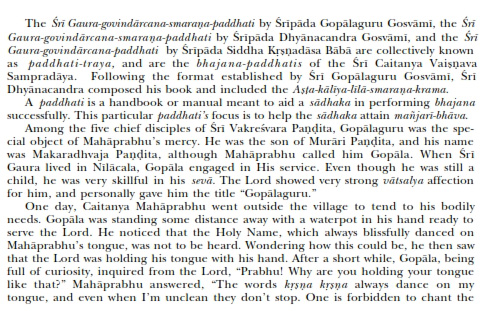
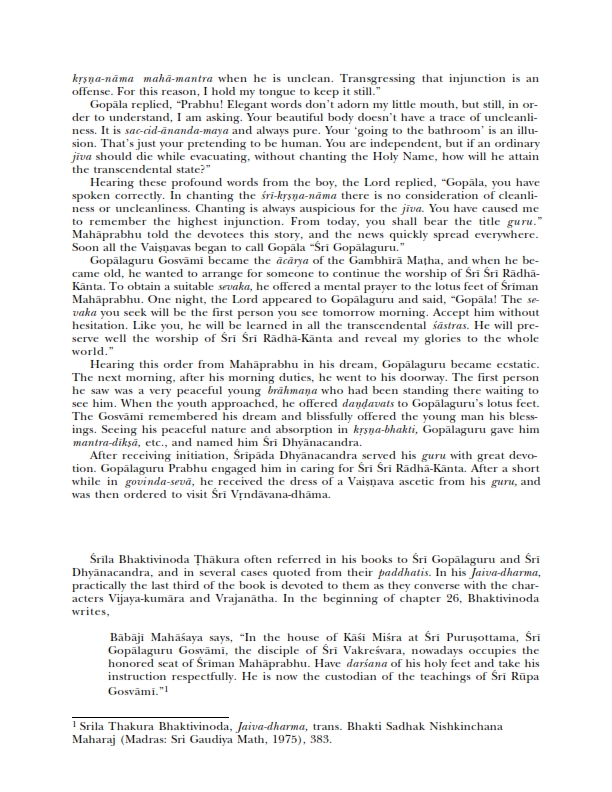
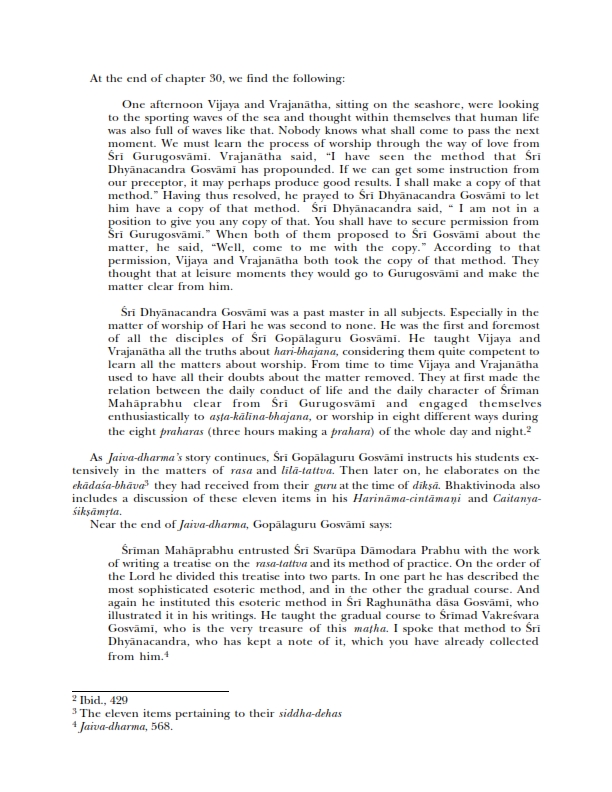
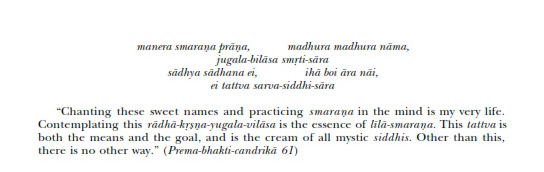
Now, Sripad Dhyanachandra Goswami and his famous Gurudeva, who was an associate of Sriman Mahaprabhu, are also mentioned there:
Sadhaka:
Wow…I never knew much about Sripad Dhyanachandra Goswami…only that he wrote the famous handbook (paddhati).
Also, another last thing, they say that we will never be able to meditate on our eternal form if we don´t chant at least 64 rounds daily.
Gurudeva:
Like I mentioned, the REAL THING happens at the stage of ASAKTI. There, we really can see and feel our siddha deha and do proper smaranam.
But all depends on MERCY…
It is a very thing to chant at least 64 rounds everyday…but how do we chant these rounds? With feelings or mechanically?
When we chant with feeling and under the guidance of our Gurudeva, everything is possible.
Realization can come in a flash. Mercy is the most important thing.
We clean our hearts, then mercy can descend.
But if we think that WE ARE THE DOERS, nothing will be DONE.
nitya-siddha krishna-prema ‘sadhya’ kabhu naya
sravanadi-suddha-citte karaye udaya
Krishna-prema is a potentiality which eternally exists in the hearts of the living entities.
It is not something to be gained from another source.
When the heart is purified by hearing and chanting (under the guidance of sad-guru) this love naturally awakens.
We can NEVER force bhakti to come in our heart…but it can happan in one second…by the mercy of a sadhu.
sa ca bhagavat kripa hetuko’nuragi bhakta kripa hetukas ceti dvividhah. tatra bhakta kripa hetuko dvividhah praktana adhunikas ca. praktanah – paurva bhavika tadrisa bhakta kripotthah, adhunikah etaj janmavadhi tadrisa bhakta kripotthah. adye sati lobhanantaram tadrisa guru caranasraya¬nam. dvitiye guru caranasrayanantaram lobha pravrittir bhavati. yad uktam: krishna tad bhakta karunya matra lobhaika hetuka pushti margataya kaiscid iyam raganugocyate
“There are two causes for the appearance of the aforementioned sacred greed: The mercy of God or the mercy of another anuragi devotee. There are again two kinds of mercy bestowed by a devotee: praktana and adhunika. praktana means mercy bestowed by a raganuga bhakta in a previous life, and adhunika is mercy bestowed in the present birth. The praktana-devotee takes shelter of the lotus feet of a raganuga guru after the sacred greed has arisen in him, the adhunika will get that sacred greed only after having surrendered to the feet of such a guru. It is said (in Bhakti Rasamrita Sindhu): “The only causes of the appearance of sacred greed is the mercy of Krishna or His devotee. Therefore some call the path of raganuga bhakti also pushti marga (the path of grace).”
(RVC)
After giving the definition of the cause of sacred greed the blessed author now describes the causes for attaining this greed. Greed for raganuga bhajana can only be attained by the grace of Sri Krishna or the grace of the great saints that are themselves passionately attached to the sweet feelings of Sri Krishna’s associates. Krishna rarely bestows His mercy on new aspirants, therefore almost always this sacred greed arises by the grace of the aforementioned saints.
There are two kinds of sacred greed that arises by the grace of the saints – praktana and adhuniki. Those who have attained lobha by the mercy of raganuga saints in previous births will revive the cultivation of that lobha in their present birth and go on with raganuga bhajana, taking shelter of the feet of a guru according to their previous lives’ samskara (cultivation), which can be dasya or sakhya or so. Those who did not cultivate such greed in their previous lives first take shelter of the lotus feet of a guru, and after they hear about the great love of Sri Krishna and His eternal associates the greed awakens within them. There is no other means than the grace of Sri Krishna and His pure devotees to attain this greed for raganuga bhajana, and the blessed author has proven it by quoting a sloka from Bhakti Rasamrita Sindhu.
In his commentary on this sloka Srimat Jiva Gosvamipada has written:
krishneti – matra padasya vidhi marge kutracit karmadi samarpanam api dvaram bhavatiti tad vicchedarthah prayoga iti bhava.
“The word matra is used in the above sloka ‘krishna tad-bhakta karunya matra labhaika hetuka’ because sometimes the offering of fruitive activities can lead to entry into vaidhi bhakti, whereas raganuga bhakti is only (matra) attained through grace.”
Greed for raganuga bhakti is more rarely attained than bhava or rati in vidhi bhakti, and it is only attainable through grace (Sri Mukunda Dasa Gosvami).
The devotees from the Vallabha Sampradaya call this raganuga marga pushti marga (the path of grace).
‘sadhu-sanga’, ‘sadhu-sanga’ — sarva-sastre kaya
lava-matra sadhu-sange sarva-siddhi haya
“The verdict of all revealed scriptures is that by even a moment’s association with a pure devotee, one can attain all success.
Sadhaka:
With a full heart, I thank you.
Gurudeva:
My blessings to you.
_________________________________
This fiction is based on the precious input of:
– my Gurudeva Srila Ananta das Babaji
http://www.jayasriradhe.com
– Sripad Prem Gopal Goswami
http://nityanandavamsha.com/2012-06-04-14-51-36/prabhupad-s-premgopal-g
– Sripad Haricarana das
http://haricarana.blogspot.de/
– Sripad Satya Narayana das Babaji
http://www.jiva.org/the-two-divisions-of-pure-bhakti-part-2/
thanks
❤

 Amrita-Tarangini